Pregnant employees in Singapore can challenge a wrongful dismissal through the Tripartite Alliance for Dispute Management, or TADM. Pregnancy is not a legitimate reason to end employment. A recent published tribunal decision, JKP v JKQ [2026] SGECT 13, awarded an employee S$19,800 after finding that her resignation had been compelled by her employer and was connected with pregnancy-related leave.
The case has attracted renewed attention because the written decision was published on September 22, 2026, although the tribunal had delivered its oral judgment in July 2024. The publication date should therefore be distinguished from the dates of the employment events and the original hearing.
Singapore’s protections involve several related questions: why the employment ended, whether the employee was entitled to maternity benefits, what evidence exists and whether a claim meets the applicable conditions. An employer giving notice does not automatically make a pregnancy-related dismissal lawful.
The reason for dismissal and the circumstances surrounding it matter. A genuine, properly supported employment decision must be distinguished from one that penalises pregnancy or the exercise of leave rights. A resignation can also be relevant when the employee can show that the employer effectively forced her to leave.
What the Recent Tribunal Found
In JKP v JKQ, the employee had received positive performance assessments before pregnancy-related hospitalisation leave and maternity leave. The tribunal rejected the employer’s unsupported explanation for wanting to end her employment. It found a constructive dismissal connected with her impending absence.
The S$19,800 award comprised S$9,900 for lost income and S$9,900 for harm caused. Those amounts reflected the facts and limits considered in that case. They should not be presented as an automatic payment available to every pregnant employee whose employment ends.
Pregnancy and Maternity Benefits
The Ministry of Manpower states that employees who have worked for an employer for at least three months have protection against wrongful dismissal during pregnancy and related maternity-benefit rights. The detailed requirements still matter, including the employee’s circumstances and the timing of the relevant notice.
MOM’s maternity-dispute guidance directs affected employees to TADM where they believe they were wrongfully dismissed and have not received maternity leave benefits. A claim about those benefits and a complaint about discriminatory treatment may overlap, but they should be described accurately when seeking assistance.
Dismissal With Notice
An employment contract may allow termination with notice or salary in lieu of notice. That contractual mechanism does not settle whether the actual reason is wrongful. MOM identifies discriminatory reasons and punishment for exercising employment rights among the matters relevant to a wrongful-dismissal claim.
Conversely, pregnancy does not mean that every termination, whatever its circumstances, is automatically wrongful. A dispute requires examination of the stated reason and supporting evidence. Employees and employers should avoid treating either the pregnancy or the existence of a notice clause as the entire answer.
When a Resignation Is Disputed
Constructive dismissal concerns a resignation that was not genuinely voluntary but was compelled by employer conduct. The recent case illustrates why the wording of communications and the sequence of events can be important. A resignation letter alone may not explain everything that led to the employment ending.
An employee considering whether pressure amounted to dismissal should describe what happened factually: who said what, when it happened and what alternatives were offered. Whether that evidence satisfies the legal test is a separate assessment. A disagreement or an unpleasant conversation does not automatically establish a successful claim.
Filing a Claim
TADM provides advisory and mediation services for employment disputes. Its published filing guidance lists a deadline of two months after childbirth for wrongful-dismissal claims during pregnancy. Other wrongful-dismissal claims generally have a different time limit, so an employee should check the category that applies rather than assume the longest period is available.
Eligibility conditions can also differ. MOM’s general guidance states that managers and executives dismissed with notice or salary in lieu ordinarily need at least six months of service for a wrongful-dismissal claim. Pregnancy-related maternity protections have their own conditions, making a direct assessment through TADM important.
Records That Help Explain a Dispute
Relevant records can include the employment agreement, payslips, performance reviews, leave applications, medical certification already provided to the employer, and messages concerning termination. Their purpose is to establish a coherent chronology. Original documents should be kept securely, with dates and full context preserved.
Written records can help distinguish an existing performance issue from a reason introduced only after pregnancy was disclosed. They can also clarify whether leave was approved, whether benefits were paid and what the employer said about a return to work. No single document guarantees the outcome.
The October 2026 Policy Update
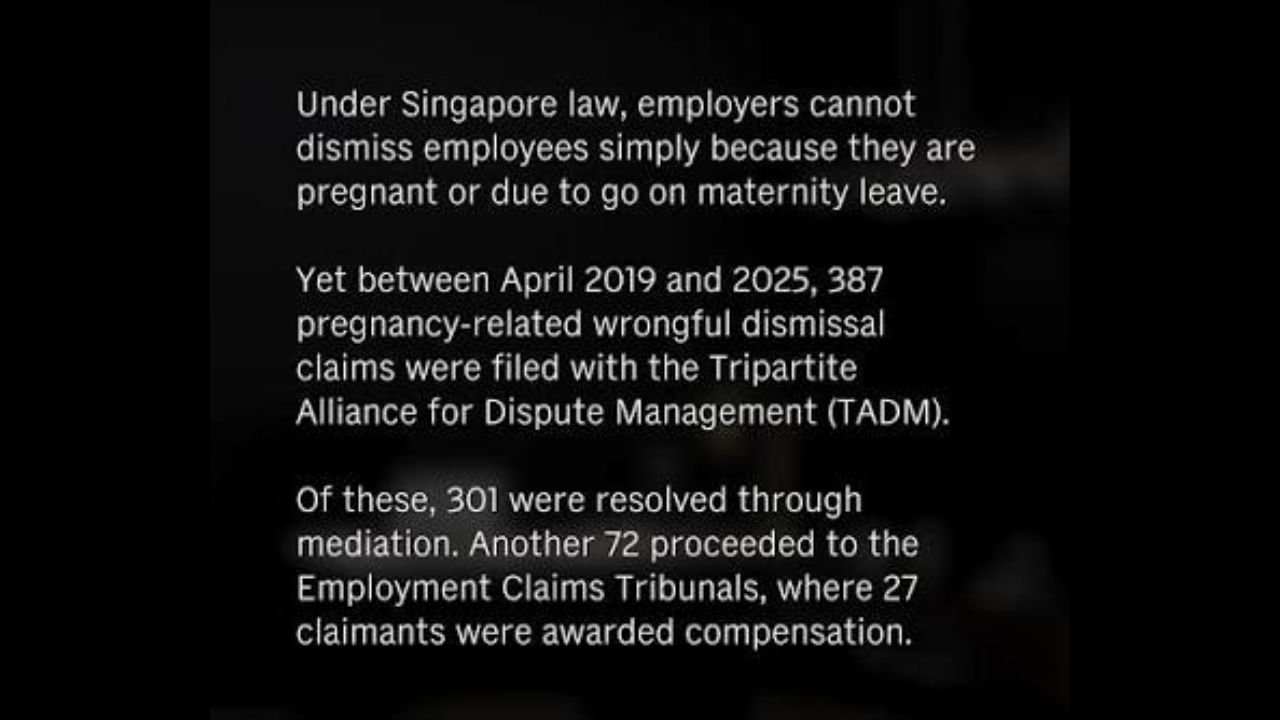
In an October 7 parliamentary answer, MOM reported 387 pregnancy-related wrongful-dismissal claims filed at TADM between April 2019 and 2025. Of these, 301 were resolved through mediation. The ministry also said the Workplace Fairness Act was scheduled to take effect by the end of 2027.
That future framework should not be described as already operating in October 2026. Existing Employment Act protections and TADM processes remain the immediate reference points. The practical lesson from the recent case is that pregnancy-related leave rights, the true reason for an employment decision and clear contemporaneous evidence all deserve careful attention.