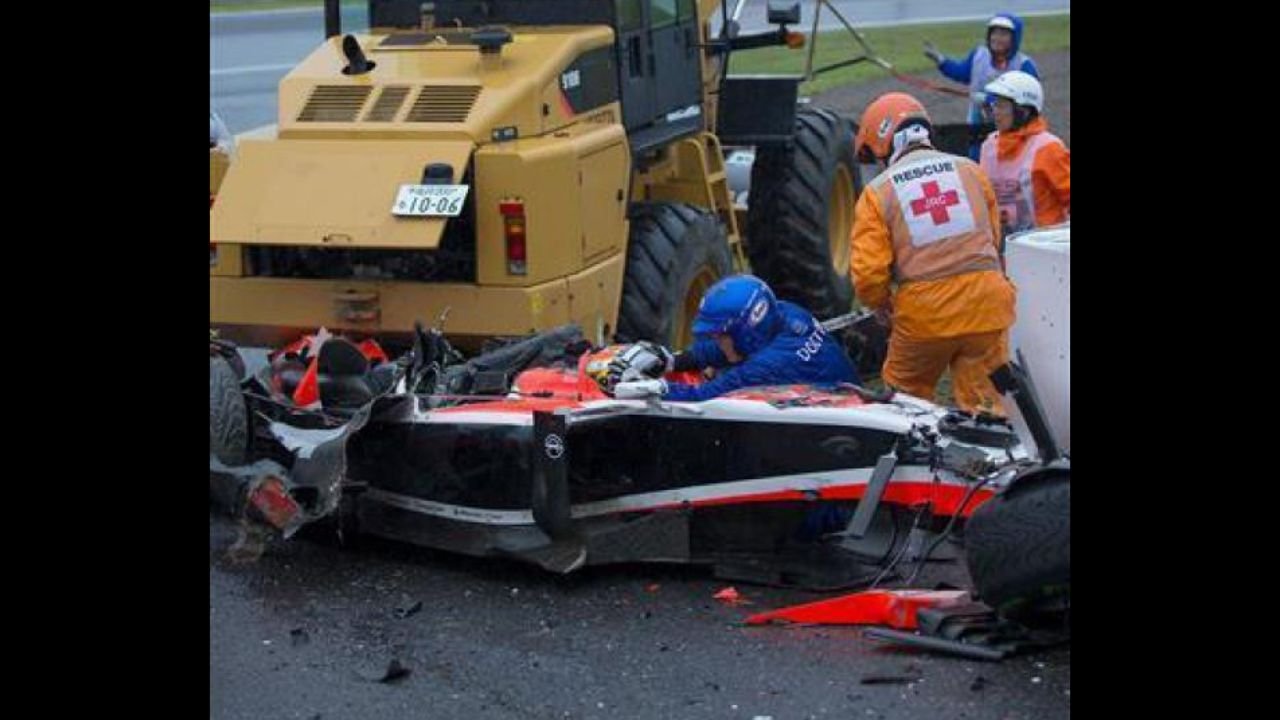
Jules Bianchi suffered a devastating Formula 1 accident during the Japanese Grand Prix at Suzuka Circuit on October 5, 2014, when his Marussia car collided with a heavy recovery vehicle in dangerous wet conditions. The French racing driver sustained a severe brain injury and remained unconscious for months before dying on July 17, 2015, at the age of 25. His death became one of Formula 1’s most heartbreaking tragedies and prompted major changes to racing safety procedures.
More than a decade later, Bianchi’s accident remains a defining moment in motorsport history, particularly because it exposed the dangers of recovery vehicles operating near racing cars during poor weather.
What Happened?
The accident occurred during the closing stages of the 2014 Japanese Grand Prix at Suzuka, where heavy rain had made the circuit extremely slippery.
The weather was influenced by Typhoon Phanfone, which brought difficult driving conditions and reduced visibility.
Bianchi was competing for the Marussia Formula 1 team when another driver, Adrian Sutil, lost control of his Sauber at Turn 7.
Sutil’s car aquaplaned off the track and struck the barriers, prompting marshals to begin recovery operations.
A heavy mobile crane was brought into the gravel trap to remove the damaged vehicle.
Unfortunately, Bianchi approached the same corner shortly afterward.
Fatal Collision
On Lap 43, Bianchi’s Marussia MR03 lost traction while traveling through the wet Dunlop Curve.
Standing water caused the car to aquaplane, leaving the French driver unable to maintain control.
His vehicle slid off the circuit and entered the gravel trap, where the recovery crane was operating.
Bianchi’s car struck the rear of the heavy machinery at approximately 123 km/h (76 mph).
The collision was exceptionally violent because the recovery vehicle was much heavier and more rigid than the Formula 1 car.
The impact caused catastrophic damage to the car’s upper structure and exposed Bianchi to enormous deceleration forces.
Crash Impact
The accident generated extraordinary forces that overwhelmed the protective structures of Bianchi’s racing car.
Reports examining the collision have cited a peak impact measurement of approximately 254g, illustrating the extreme violence involved.
The car’s roll structure was severely damaged as it passed beneath the recovery vehicle.
Unlike conventional track barriers, the crane did not have an energy-absorbing structure designed to protect a racing driver during a high-speed collision.
The accident demonstrated how dangerous heavy equipment could become when positioned inside an area where another car might leave the circuit.
Medical Emergency
Bianchi was unconscious following the crash and required immediate assistance from medical personnel.
Emergency responders worked to stabilize him before arranging transportation to hospital.
Because of the severe weather conditions, helicopter evacuation was not considered suitable.
He was transported by ambulance to Mie University Hospital in Japan, where doctors assessed his critical injuries.
Medical examinations revealed extensive damage to his brain.
The French driver underwent emergency treatment, but his condition remained extremely serious.
Brain Injury
Doctors diagnosed Bianchi with a diffuse axonal injury, a traumatic brain injury involving widespread damage to nerve fibers.
Such injuries can occur when the brain experiences rapid acceleration, deceleration or rotational forces.
Bianchi’s condition required intensive medical care, and he remained unconscious after the accident.
In November 2014, he was transferred from Japan to a hospital in Nice, France, allowing him to receive treatment closer to his family.
Despite continued medical attention, he never regained consciousness.
His family provided updates during the months following the crash while maintaining hope for his recovery.
When Did He Die?
Jules Bianchi died on July 17, 2015, nine months after his accident at Suzuka.
He was only 25 years old.
His family confirmed his death in France, bringing an end to a prolonged period of medical treatment.
Bianchi became the first Formula 1 driver to die from injuries sustained during a Grand Prix weekend since Ayrton Senna’s fatal accident at Imola in 1994.
His death deeply affected the motorsport community, including fellow drivers, teams and fans who had followed his promising career.
FIA Investigation
Following the crash, the Fédération Internationale de l’Automobile (FIA) established an accident panel to examine the circumstances.
Investigators reviewed the weather, track conditions, recovery operations and Bianchi’s approach to the corner.
The panel identified several contributing factors, including dangerous conditions and insufficient speed reduction under double yellow flags.
It also examined the risks associated with placing heavy recovery equipment in areas where racing cars could lose control.
The investigation resulted in recommendations intended to reduce the likelihood of similar incidents.
The findings emphasized the importance of managing vehicle speeds and recovery operations together.
Safety Changes
One of the most significant developments following Bianchi’s accident was the introduction of the Virtual Safety Car (VSC) system.
Implemented in Formula 1 in 2015, the system requires drivers to follow a controlled speed reduction when dangerous conditions arise.
Unlike traditional local yellow flags, the VSC provides a more consistent method of slowing cars across the circuit.
The sport also strengthened procedures for handling recovery vehicles and assessing hazardous track conditions.
These changes aimed to protect drivers, marshals and emergency personnel during incidents.
Halo Protection
Another major safety development was the introduction of the Halo cockpit protection device in 2018.
The titanium structure helps protect drivers from certain impacts involving debris, other vehicles and objects near the cockpit.
Although Bianchi’s accident contributed to broader discussions about cockpit safety, the Halo was not developed solely because of his crash.
Its effectiveness in the precise circumstances of Bianchi’s collision cannot be assumed.
Nevertheless, the device has since demonstrated its value in several serious motorsport accidents.
Charles Leclerc Connection
Bianchi shared a particularly close relationship with Ferrari Formula 1 driver Charles Leclerc.
The two families had longstanding connections, and Bianchi became an important mentor to Leclerc during his early racing career.
Leclerc has repeatedly acknowledged Bianchi’s influence on his development as a driver.
Bianchi was also regarded as a promising Ferrari-affiliated talent before his accident, making his loss especially significant within the team’s racing community.
His memory continues to hold a special place in Leclerc’s career.
Lasting Legacy
As of November 2026, Jules Bianchi’s accident remains one of the most influential safety tragedies in modern Formula 1.
His death prompted extensive examination of racing procedures and helped accelerate improvements in how dangerous situations are managed.
The Virtual Safety Car, stricter recovery procedures and continued cockpit protection research reflect the sport’s broader commitment to preventing avoidable fatalities.
Bianchi is remembered not only for the circumstances of his death but also for his talent, determination and promising Formula 1 career.
The French driver was just 25 when he died, but his legacy continues to influence motorsport safety more than 11 years later.