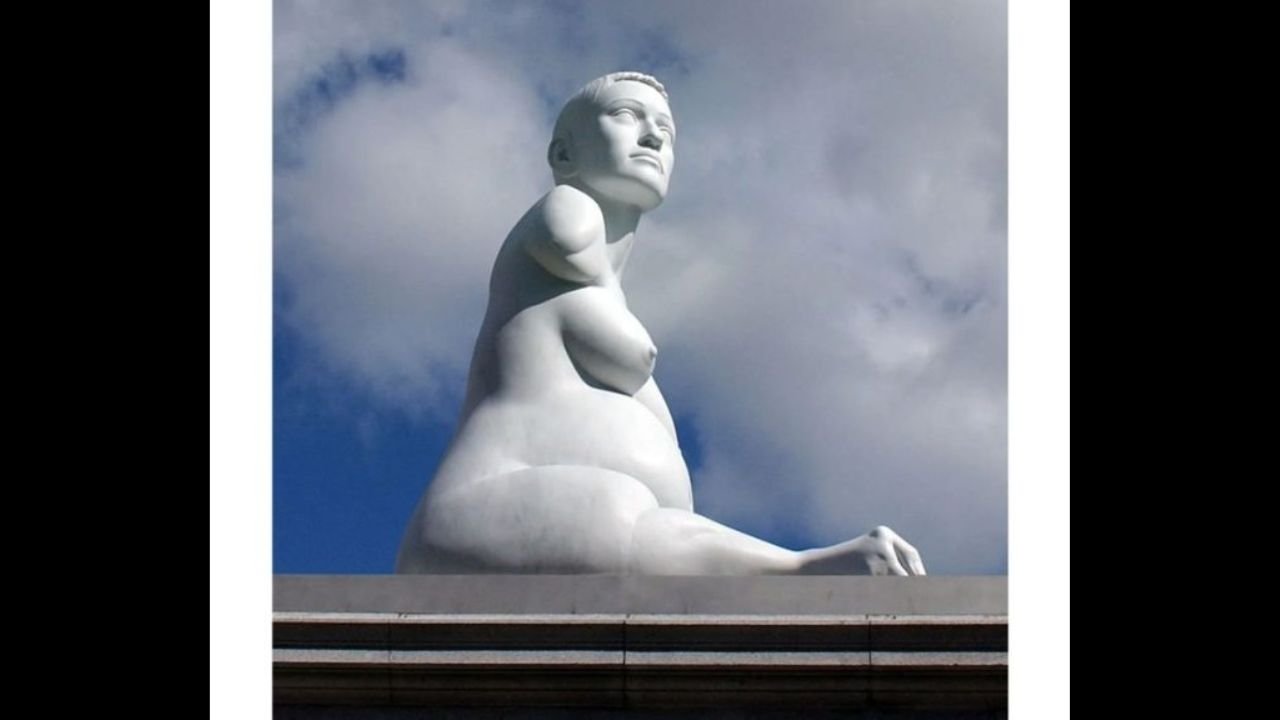
Alison Lapper Pregnant is one of Britain’s most memorable public sculptures, depicting a disabled woman during the final months of pregnancy. Created by British artist Marc Quinn, the monumental marble artwork became a major talking point when it appeared in London’s Trafalgar Square in September 2005.
Unlike traditional statues honoring military commanders, monarchs or political leaders, this sculpture celebrates a living woman, her body and her experience of motherhood. Its striking appearance challenged familiar ideas about beauty, disability and who deserves recognition in public spaces.
Nearly two decades after leaving Trafalgar Square, the sculpture continues to attract attention for its artistic significance and cultural impact.
What Is Alison Lapper Pregnant?
Alison Lapper Pregnant is a 3.55-metre-tall marble sculpture created by Marc Quinn in 2005. It portrays British artist Alison Lapper sitting naked while eight months pregnant.
The sculpture was carved from white Carrara marble, a material historically associated with classical European sculpture.
Its subject, Alison Lapper, was born with phocomelia, a congenital condition affecting the development of her limbs. She has no arms and shortened legs.
Rather than concealing these physical characteristics, Quinn presented Lapper’s body openly and confidently.
The work invited viewers to reconsider conventional expectations of the human figure, particularly in monumental sculpture.
Who Is Alison Lapper?
Alison Lapper was born on April 7, 1965, in Burton upon Trent, England. She is a British visual artist, writer and disability advocate whose work explores identity, physical difference and personal experience.
Born without arms, Lapper developed creative techniques using her mouth and feet.
She studied fine art at the University of Brighton and established herself as an artist before becoming the subject of Quinn’s sculpture.
Her achievements include being appointed Member of the Order of the British Empire (MBE) in recognition of her contributions to art.
Although the Trafalgar Square monument brought her international recognition, Lapper has consistently maintained her own artistic career.
Who Created It?
The sculpture was created by Marc Quinn, a contemporary British artist known for exploring the relationship between the human body, identity and society.
Quinn became associated with the Young British Artists movement, which gained prominence during the 1990s.
His work frequently examines subjects that challenge conventional artistic representation.
For Alison Lapper Pregnant, he chose a classical sculptural material while presenting a body rarely celebrated in traditional public monuments.
The contrast between the familiar marble surface and the unexpected subject became one of the artwork’s defining features.
Size and Material
The original sculpture measures approximately 3.55 metres (11.6 feet) in height and weighs around 13 tonnes.
It was carved from Carrara marble, sourced from the Italian region famous for producing stone used in important European sculptures.
Its substantial weight and height gave the artwork a commanding presence above Trafalgar Square.
The white marble also connected Quinn’s contemporary subject to the visual language of ancient Greek and Roman sculpture.
However, instead of depicting an idealized mythological figure, the monument presented the physical reality of a modern woman.
Trafalgar Square Debut
Alison Lapper Pregnant was unveiled on September 15, 2005, on the Fourth Plinth in London’s Trafalgar Square.
The Fourth Plinth was originally intended for an equestrian statue but eventually became a platform for temporary contemporary artworks.
Quinn’s sculpture remained there until late 2007.
Its installation attracted considerable media coverage and public discussion.
Some observers welcomed the representation of a disabled mother in such a prominent location. Others questioned whether the artwork suited the historic surroundings.
The debate itself helped establish the sculpture as an important moment in British public art.
Why Was It Controversial?
The sculpture challenged several long-established conventions.
Public monuments have traditionally celebrated military victories, political authority and idealized physical strength.
Quinn instead presented a pregnant woman with visible limb differences.
The subject’s nudity, pregnancy and disability challenged expectations about which bodies could be displayed prominently in civic spaces.
For supporters, the work represented dignity, visibility and a broader understanding of human beauty.
Critics raised questions about its presentation and the relationship between the sculptor and his subject.
These differing responses became central to conversations about disability representation and public art.
London Paralympics Connection
The sculpture reached another international audience during the London 2012 Paralympic Games opening ceremony.
A giant inflatable version, inspired by Quinn’s original marble work, appeared during the event.
The reproduction measured approximately 12 metres tall, making it considerably larger than the Trafalgar Square sculpture.
Its appearance connected the artwork with a global celebration of disabled athletes and their achievements.
The ceremony introduced the image of Alison Lapper to viewers who had never encountered the original monument.
It also strengthened the sculpture’s association with disability visibility in contemporary culture.
Her Son Parys
The pregnancy represented in the sculpture was real.
Alison Lapper was carrying her son, Parys, who was born in 2000, when she posed for Quinn.
Motherhood became an important part of her public story, particularly as she challenged assumptions about disabled parents.
Tragically, Parys died in August 2019 at the age of 19.
Lapper has spoken publicly about her grief and her son’s experiences with mental health difficulties.
His death adds a deeply personal dimension to the sculpture, which preserves an earlier moment in their lives.
Its Lasting Legacy
Today, Alison Lapper Pregnant remains an influential example of contemporary British public sculpture.
Its significance extends beyond its size, material or original location.
The artwork brought disability, motherhood and physical identity into a prominent civic setting where such subjects had rarely received comparable recognition.
It also encouraged wider discussion about whose lives public monuments should celebrate.
Alison Lapper Pregnant is remembered not simply as a marble statue, but as an artwork that challenged traditional ideas of beauty, heroism and representation.
Its presence in Trafalgar Square and later appearance at the Paralympics ensured that its message reached audiences far beyond the art world.