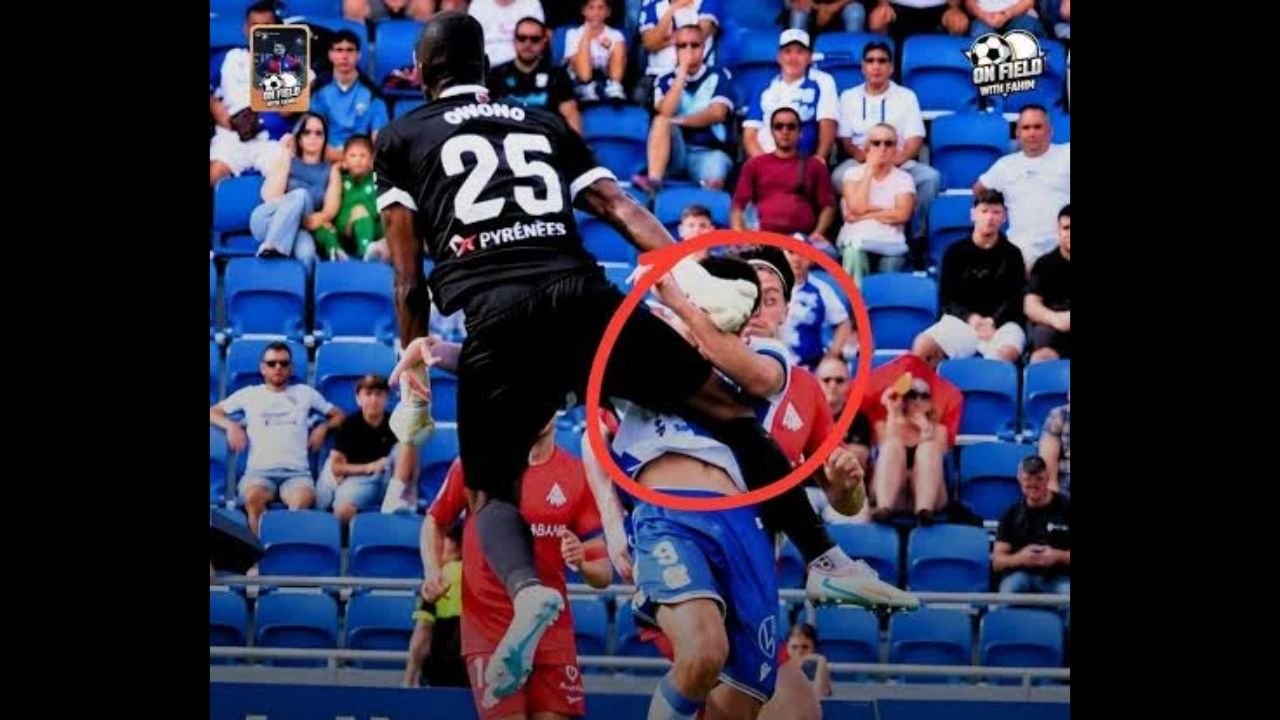
Spanish footballer Jesús de Miguel died at the age of 30 following a devastating on-field collision during CD Tenerife’s match against FC Andorra. The incident occurred in the closing moments of a Segunda División fixture when goalkeeper Jesús Owono rushed forward to challenge the striker for a long ball. De Miguel collapsed after the impact and suffered a cardiac arrest. Despite emergency treatment and intensive care, CD Tenerife announced his death on Tuesday, November 3, 2026.
The tragedy prompted an outpouring of grief across Spanish and European football, alongside questions about player safety, disciplinary action, and the circumstances surrounding the collision.
What Happened?
The accident reportedly occurred in the 96th minute of the match between CD Tenerife and FC Andorra.
With the score level at 2–2, De Miguel was chasing a long ball near the centre of the pitch.
Andorra goalkeeper Jesús Owono had advanced well outside his penalty area to intercept the ball.
As the two players approached each other, Owono jumped forward while attempting to make a clearance.
According to match reports, his raised knee struck De Miguel heavily around the upper body.
The collision left the Tenerife forward seriously injured, and the match quickly came to a halt.
Moment of Impact
The challenge happened during the final moments of a closely contested game.
De Miguel was moving toward the ball when Owono came forward from his goalkeeping position.
Reports described significant contact involving the striker’s chest and head.
De Miguel briefly held his torso before falling backward onto the pitch.
He then remained motionless, immediately raising concerns among players, officials, and spectators.
Medical personnel were called onto the field as the seriousness of the situation became apparent.
The sudden change from an ordinary football challenge to a medical emergency shocked those watching the match.
Medical Emergency
Jesús de Miguel suffered a cardiorespiratory arrest following the collision, according to published reports.
Emergency responders began treating him on the pitch.
Cardiopulmonary resuscitation, commonly known as CPR, was reportedly performed in an effort to restore circulation.
Medical teams continued working as the player was prepared for emergency transport.
Reports indicated that his pulse was temporarily restored during the ambulance journey.
The striker was taken to Hospital Universitario de Nuestra Señora de Candelaria in Tenerife for specialist treatment.
Although he reached hospital alive, his condition remained extremely serious.
Hospital Treatment
De Miguel was admitted to intensive care following the emergency.
Initial reports reportedly described his condition as critical but stable, offering some hope that he might recover.
However, subsequent updates indicated that his neurological condition had deteriorated.
Medical specialists continued treatment, but he reportedly never regained consciousness.
CD Tenerife announced that De Miguel died at approximately 8:00 a.m. on November 3, 2026.
His death came after medical teams had spent hours attempting to stabilise his condition.
The announcement confirmed the worst fears of supporters who had been following developments since the collision.
Cause of Death
The immediate medical emergency was described as cardiorespiratory arrest following blunt-force trauma during the collision.
A cardiac arrest occurs when the heart suddenly stops pumping blood effectively.
Without immediate intervention, the interruption of circulation can cause severe damage to vital organs, particularly the brain.
Reports linked De Miguel’s collapse to the force of the impact.
However, determining the precise physiological mechanism and final medical cause requires authoritative medical findings.
The reported sequence of events should not be treated as a substitute for a complete medical or forensic assessment.
Match Abandoned
The match between Tenerife and Andorra was suspended after the medical emergency.
The score stood at 2–2 when play was stopped.
As emergency responders attended to De Miguel, the atmosphere inside the stadium changed dramatically.
Players and supporters were left waiting for information about his condition.
Officials ultimately abandoned the fixture rather than attempting to resume normal play.
The decision reflected the seriousness of the incident and its impact on everyone involved.
Any arrangements concerning the match result or a possible replay would require confirmation from the relevant competition authorities.
Goalkeeper’s Red Card
Jesús Owono was reportedly shown a straight red card following the challenge.
Match officials considered the incident serious enough to warrant his dismissal.
The decision subsequently attracted attention because of the tragic medical outcome.
Reports suggested Owono could face a suspension under Spanish football disciplinary regulations.
Some accounts discussed a possible punishment ranging from four to twelve matches, depending on the applicable rules and final disciplinary findings.
However, that range should not be confused with an officially imposed sanction.
Any confirmed suspension would need to be announced by the responsible football disciplinary body.
Police Investigation
Spanish authorities reportedly opened an investigation into the circumstances of De Miguel’s death.
According to published accounts, the inquiry involved the National Police’s Homicide Division.
The investigation was described as a judicial process examining the circumstances of a fatal incident.
Such an inquiry does not automatically establish criminal wrongdoing.
Investigators may review available footage, witness accounts, medical findings, and other relevant evidence.
Reports also raised the possibility of examining whether the incident involved involuntary manslaughter.
However, no criminal conviction or final finding of responsibility has been established in the supplied information.
It is important to distinguish an investigation from an allegation proven in court.
Reaction to Owono
The incident also generated intense online discussion about goalkeeper Jesús Owono.
Some supporters criticised the challenge, while others cautioned against assigning criminal responsibility before investigators completed their work.
Reports indicated that Owono subsequently deactivated his social media accounts following widespread criticism.
The goalkeeper’s actions during the match may be assessed through separate sporting and legal processes.
A red card, disciplinary suspension, and criminal finding are different matters, each requiring its own assessment.
The tragic outcome does not remove the need for a fair examination of the available evidence.
Football Tributes
De Miguel’s death prompted expressions of sympathy from clubs, players, and football organisations.
The Royal Spanish Football Federation reportedly suspended Copa del Rey fixtures scheduled for Tuesday, November 3, following the tragedy.
UEFA was also reported to have arranged moments of silence at European matches in his memory.
These tributes reflected the impact of the news beyond Tenerife and Spain’s second division.
For teammates and supporters, De Miguel was more than a player involved in a widely reported accident.
He was a professional footballer whose career had been built through years of competition and commitment.
His Football Career
Jesús de Miguel developed his career through several levels of Spanish football.
He played for clubs including Unionistas de Salamanca, San Sebastián de los Reyes, and CD Castellón before joining Tenerife.
At Castellón, he became recognised for his attacking contributions and physical presence.
His performances helped establish him as a capable forward in Spain’s competitive football system.
His move to CD Tenerife represented another important stage in his professional journey.
At the time of his death, he was just 30 years old, with a career that had taken him from lower-division football to a prominent professional club.
Final Words
The Jesús de Miguel accident occurred during the closing moments of Tenerife’s match against FC Andorra and resulted in the striker’s death on November 3, 2026.
The collision with goalkeeper Jesús Owono led to a medical emergency, the abandonment of the match, and subsequent sporting and police investigations.
While questions remain about the precise circumstances and any disciplinary consequences, the tragedy has brought renewed attention to emergency medical care and player safety in professional football.
Jesús de Miguel’s death at 30 remains a devastating loss for his family, teammates, supporters, and the wider football community.